


Finding the daily stream of chaotic news difficult to keep up with? Get a 10-minute weekly nonpartisan update of key developments with a free subscription to Trillions National Weekly.
Prefer to listen to the audio version of this newsletter? Download the free Substack app (available on IOS and ANDROID).
Trillions National Weekly © is a publication of CAPITOL PUBLIC POLICY LLC, which provides fiscal intelligence; and research & consulting services on appropriations, entitlements, tax, and budget from the author of Trillions: A Primer. Contact us at ckonigsberg@capitolpublicpolicy.com or call (301) 509-5688.
CALENDAR UPDATE: The House and Senate are both in recess for Tuesday’s midterm congressional elections. What time do Tuesday’s polls close? Both chambers are scheduled to reconvene next Monday, November 9, 2026.
(1) MIDTERM ELECTIONS:
Final Midterm Polls show Democrats taking the House and possibly the Senate:
NYT | RCP | Silver. Currently Republicans have a three-seat majority in the Senate, 53-47. Four seats would have to flip in order for Democrats to take the majority. All three polls show Democrats possibly flipping seats in the following seven states: Alaska, Iowa, Kansas, Maine, North Carolina, Ohio, and Texas. (However, Democrats would need to flip five seats if they lose their current seat in Michigan, El-Sayed v. Rogers.)
Other factors: Two races are effectively tied which could net Democrats two more seats: in Nebraska, Democratic-backed Independent Dan Osborn is tied with Republican Pete Ricketts, and in South Carolina the Graham v. Andrews race is within the margin of error.
But read this article about possible systemic polling errors. (NYM)
Appeals court rejects Trump demand to set aside 20,000 California mail ballots (CNN); and Grand jury rejects bid by Justice Dept. to bring charges over voter fraud. (NYT)
Despite worries about federal intervention, local and state officials say they are well prepared to run a secure election. (NYT)
Trump’s final pitch before the midterms focuses on the reflecting pool and landscaping. (Axios)
(2) FISCAL NEWS – DEBT MILESTONE, SHUTDOWN, AND BUDGET RECONCILIATION:
PUBLIC DEBT HITS 100% OF GDP – HIGHEST SINCE 1946:
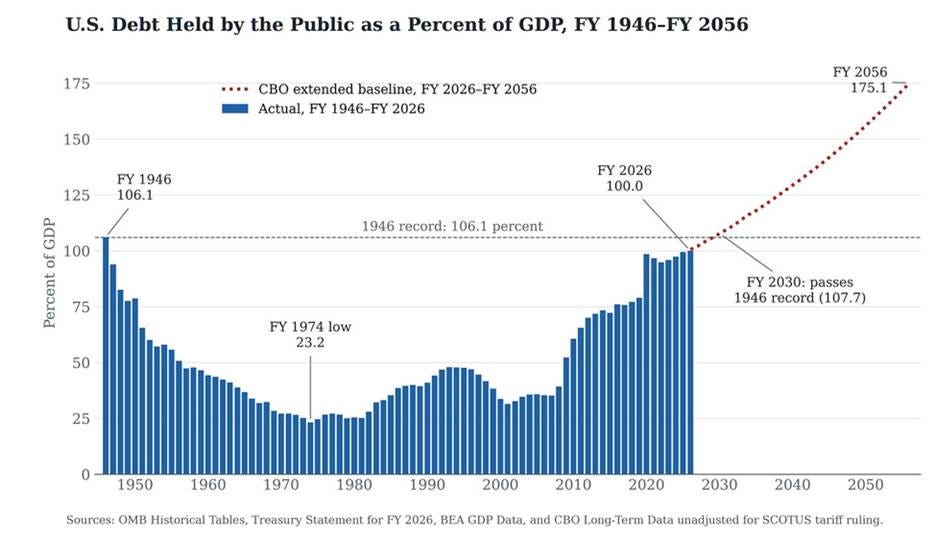
AVOIDING A DECEMBER 12 SHUTDOWN: The new fiscal year (FY 2027) began October 1, 2026. Because none of the 12 regular appropriations bills have been enacted, there is in place a stopgap funding measure (“continuing resolution”) which expires next month on Friday, December 11, 2026. Avoiding a federal shutdown on December 12 will require bipartisan agreement in the aftermath of Tuesday’s highly contentious elections—politically difficult, to say the least. Stay on top of rapidly changing developments at TrillionsWeekly.com or our webpage Appropriations.com.
REPUBLICAN-ONLY FILIBUSTER-PROOF BUDGET RECONCILIATION BILL: If either chamber flips in Tuesday’s elections, Republicans may use the upcoming lame duck session of Congress to attempt passage of a filibuster-proof, GOP-only budget reconciliation bill before Democrats take over one or both chambers in January. Possible candidates for the bill are:
Supplemental defense funding for President Trump’s Iran War, plus intelligence funding;
Funding for farmers to mitigate the impact of tariffs, high diesel, and fertilizer costs;
Grants to states to advance Trump’s voter ID and proof-of-citizenship agenda;
Large boost in overall defense spending (Trump and Hegseth are seeking for FY 2027 a nearly 50% increase in defense spending);
Spending cuts to offset the reconciliation law passed in June which funded Trump’s deportation and border operations;
Additional tax cuts and additional spending cuts as offsets; and
An increase in the statutory limit on the public debt (likely to be reached in 2027) with some Republicans hoping to avoid a separate vote on the debt limit before the 2028 presidential election.
However, Politico reports that the administration’s big defense boost could be in trouble due the President’s Russia policies: The president will need almost unanimous support from Senate and House Republicans to enact his $1.5 trillion Pentagon budget after the midterm elections, especially if the GOP is about to lose one or both chambers of Congress. But Trump’s recent receptiveness to Russia — including allowing the sale of Russian diesel fuel, waiving sanctions on Moscow and the still-unexplained slowdown of Ukraine’s satellite defenses — has alarmed the very people pushing for more military spending. And they warn that his agenda won’t survive if the embrace of Moscow continues. (Politico)
(3) MAJOR ECONOMIC, FEDERAL RESERVE, AND TARIFF NEWS:
FED KEPT INTEREST RATES UNCHANGED: Last Wednesday, the Fed held rates steady despite concerns over inflation. (CNBC) Kevin Warsh capitalizes on the inflation credibility he’s brought to the job. (WSJ) In moving gradually, Fed risks having to play catch-up to quell inflation. Fed officials are expected to restart rate increases in December. (NYT)
LABOR MARKET: U.S. jobs pickup may keep Fed on track to hike rates again. (Bloomberg)
AFFORDABIITY AND INFLATION: We talked to voters in six battleground states about the rising cost of living (WP); and ‘Nobody’s listening’: 5 things Americans told us about the economy that Washington needs to hear (CNN).
BOND MARKETS:
Global bond sales smash record, fueled by A.I. borrowing binge. (Bloomberg)
Treasury yields fall following major central banks’ hold. (WSJ)
Return to bonds after long sell-off comes as concern rises about over-reliance on tech spending. (FT)
Just ask France. As a government’s borrowing costs rise, they become prohibitive, and chaos intensifies. America, take heed. (WP)
US-CANADA TRADE WAR:
Why the US and Canada are still a ways from a trade deal: Washington and Ottawa have intensified their discussions over the past week but have yet to offer concessions. (Politico)
America Needs Canada’s Aluminum: Trump’s tariffs exposed just how badly. Smelters in Quebec run on cheap hydropower; 50% tariff pushes up prices for American industry. (WSJ)
Results of Canada’s economic break with the US: declining trade; Canada sending smallest share of exports to the U.S. in nearly 30 years; spirits exports from the US to Canada fell 85%; Canadians spending less time and money in the U.S.; and Canadian investors staged a record retreat from US stocks. (CNN)
TrillionsWeekly Comment: Section 232 lets the President adjust imports that threaten national security. It says nothing about trading tariff relief to individual companies for investment promises which, not coincidentally, were announced at a campaign stop shortly before the midterm elections.
(4) POLITICAL, LEGAL, MEDIA, AND ETHICS NEWS:
MEDIA AND THE FIRST AMENDMENT: Judge tosses Trump’s $10 Billion suit against the Wall Street Journal. The defamation suit focused on an article about a birthday note to Jeffrey Epstein. It was the president’s second attempt to claim the publication had acted with actual malice. (NYT)
TRUMP ADMINISTRATION CORRUPTION:
As Trump brags about U.S. oil and gas company profits, his stocks gained millions during Iran war. (CBS)
How corruption became a top voter issue in the US midterms. (FT)
The Trump sons’ global network: money, influence, and the family business. (FT)
TRUMP’S ENERGY COUNCIL: Ostensibly created to bring down costs, the National Energy Dominance Council operates in secrecy. What we know about it is disturbing. (TNR)
(5) ARTIFICAL INTELLIGENCE (“A.I.”) AND THE BINANCE CRYPTO HACK:
THE $6.3 BILLION CRYPTO HACK: Binance’s $6.3 billion hack Is just the start of a risky new era. The largest cyber heist in history came as attackers increasingly use artificial intelligence and other advanced techniques to steal crypto and quickly launder the funds. (NYT) What protections exist for Binance’s customers?
A.I. AND THE ECONOMY: How much is A.I. contributing to the economy? (Bloomberg)
HUMANOID ROBOTS: Germany’s Neura is one of the companies at the forefront of efforts to use artificial intelligence in robotics, and crucial to whether Europe can close the gap with China... Smart robots in factories, warehouses, hospitals, and hotels are forecast to play a critical role as countries cope with aging populations and shrinking work forces. The number of humanoids deployed worldwide could rise to one million in 2030 from 15,000 last year. (NYT)
TrillionsWeekly comment: Workforces are “shrinking” in advanced economies due to low birth rates, aging populations, and limits placed on immigration. Those who oddly prefer robots to people fail to consider that shifting from workers to robots would decrease payroll tax receipts and place Social Security and Medicare on a steeper decline to insolvency.
MICROSOFT REPLACING WORKERS WITH A.I.: Microsoft offers buyouts to 60,000 staff. Tech giant moves to control costs as it spends up to $175bn on AI infrastructure this year. (FT)
ANTHROPIC’S IPO: Anthropic files for potentially the biggest IPO ever as CEO warns of risk to humanity from A.I. (AP)
TAXING A.I.: Taxing Artificial Intelligence -- What’s on the table, and what’s at stake. (TPC)
(6) HEALTH, CLIMATE, AND ENERGY NEWS:
WANT GOOD NEWS? Look at health care innovation. (WP)
OBAMACARE PREMIUMS TO SPIKE, AGAIN: Premiums will increase an average 13 percent next year for millions of Americans, on top of an earlier steep increase. (NYT)
CONSOLIDATION HAS DRIVEN UP HEALTHCARE PRICES: Decades of consolidation in the healthcare industry have reduced competition and given hospitals and other providers more power over prices, driving up the cost of care. (Bloomberg)
MEDICAID: Judge blocks Trump administration’s Medicaid rule forcing sick recipients to prove frailty. (AP)
KENNEDY AND PEPTIDES: Kennedy to allow broad use of unapproved peptide injections. The F.D.A. had advised against the move. (NYT)
RELAXING METHANE RESTRICTIONS: Trump says he’s ending restrictions on climate-warming methane from oil drilling. (AP)
(7) OTHER U.S. DEVELOPMENTS:
IMMIGRATION: U.S. to send dozens back to Afghanistan, despite risk of persecution. The Trump administration plans to fly the Afghan immigrants from Louisiana to Pakistan, where they are expected to be expelled over the border to Afghanistan. (NYT)
SOCIAL SECURITY: What’s behind a recent spike in early Social Security claims? Experts point to well-publicized turmoil at the agency last year as a potential spark. (NYT)
TROUBLE FOR DEFENSE SECRETARY HEGSETH: Politico reports that Jeffries is edging closer to a Hegseth impeachment as he eyes the gavel.
However, keep in mind that once the House impeaches a cabinet member, a trial takes place in the Senate where removal requires a 2/3 vote (a very high bar).
(8) GLOBAL DEVELOPMENTS:
UKRAINE – RUSSIA NEWS:
IRAN – ISRAEL – MIDEAST NEWS:
Qatari negotiators return to Tehran in last-ditch mediation effort aimed at preventing an intense new round of war. (FT) Iranian officials spoke of some progress in negotiating to reopen the strait even as they prepared for all-out war. A Qatari delegation arrived in Tehran on Monday to meet with the foreign minister to continue talks. (NYT)
Iran war’s cost to American taxpayers grows to an estimated $47.1 billion. (AP)
Visit our digital library of fiscal and public policy resources.
Speaking engagements and press interviews can be scheduled by calling: (301) 509-5688. Email comments, suggestions, and questions to: ckonigsberg@capitolpublicpolicy.com.
About the author: Charles S. Konigsberg J.D. served as Assistant Director, White House Office of Management and Budget; General Counsel at the U.S. Senate Finance Committee, where he had principal responsibility for managing federal budget and debt limit legislation; Minority Chief Counsel at the U.S. Senate Rules & Administration Committee where he advised the ranking member on budget, appropriations, trade, and tax legislation; Staff Attorney at the U.S. Senate Budget Committee where he had responsibility for federal fiscal law issues including the Impoundment Control Act and wrote the Senate’s first explanation of the congressional budget process; Director of Congressional Affairs at the Consumer Financial Protection Bureau and AmeriCorps; and Staff Director of the only national bipartisan budget task force to unanimously agree on a long-term debt stabilization plan. He is admitted to the U.S. Supreme Court Bar, the District of Columbia Bar, and the Ohio Bar and is the author of three books:
1. Trillions: A Primer on Federal Spending, Taxes, the U.S. Debt Ceiling, and Fiscal Law - 2024-2025 edition (Matthew Bender, 2023-24 and 2024-25 editions). The 2026-27 edition of Trillions: A Primer will be released this December on Amazon.
2. Independent Voters will Decide America’s Future in 2024 and Beyond (2024).
3. America’s Priorities: How the U.S. Government Raises and Spends $3 Trillion Per Year (2007).
